




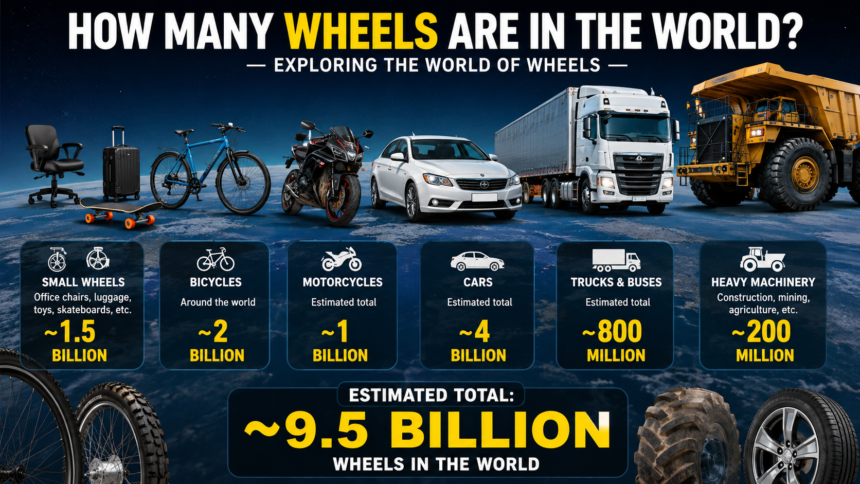
Look around a parking lot and the answer seems obvious: count the cars, multiply by four, and you’ve got a rough idea. Then consider bicycles, motorcycles, trucks, buses, trailers, wheelchairs, carts, toys, factory equipment, agricultural machinery, and thousands of other wheeled objects. Suddenly, the question how many wheels are in the world becomes surprisingly difficult.
There’s no global registry that records every wheel ever manufactured or currently in use. Wheels are produced by countless companies, replaced independently, stored as spare parts, discarded, recycled, and used in objects that never appear in transportation statistics. As a result, any worldwide figure has to be an estimate rather than an exact count.
Still, by combining known vehicle populations with reasonable estimates for bicycles, motorcycles, trailers, industrial equipment, and everyday wheeled products, we can get a useful picture of the number of wheels in the world and understand why the true total is probably enormous.
How Many Wheels Are in the World?
A reasonable broad estimate is that there are tens of billions of wheels worldwide, with a plausible range of roughly 50 billion to more than 100 billion wheels, depending on what counts as a wheel.
That range is deliberately wide. If we count only wheels attached to major transportation vehicles, the number is much lower. If we include spare tires, trailers, shopping carts, office chairs, luggage, toys, industrial machinery, agricultural equipment, and other wheeled objects, the total climbs rapidly.
For example, the global vehicle fleet alone contains billions of vehicles. Most passenger cars have four road wheels, while many also carry a spare. Commercial trucks and buses can have six, eight, ten, or even more wheels. Motorcycles generally have two, while bicycles add another huge category.
So there isn’t one scientifically established figure for the total wheels worldwide. The best answer depends on the definition used.
Why Counting Every Wheel Is So Difficult
The biggest problem isn’t mathematics. It’s deciding what should be counted.
Imagine a delivery van. Does its spare tire count? What about the spare tire sitting in a warehouse? If the van has four wheels touching the road and one unused spare, is that five wheels?
Now consider a supermarket. Hundreds of shopping carts may have four small wheels each. Office buildings contain chairs with casters. Airports use baggage carts and luggage trolleys. Factories operate conveyor systems and machinery with wheels or rollers.
There are also millions of wheels that aren’t currently attached to anything. Tire shops, vehicle repair centers, manufacturers, warehouses, and scrapyards hold enormous inventories of wheels and tires.
That makes the question how many wheels exist in the world fundamentally different from asking how many vehicles exist.
Major Sources of Wheels Around the Globe
Cars and Passenger Vehicles
Cars are one of the largest contributors to the world’s wheel population.
Global vehicle ownership has reached well over a billion motor vehicles, although the exact number varies depending on whether a source counts passenger cars only or includes commercial vehicles. Four-wheel passenger vehicles therefore represent several billion installed wheels by themselves.
And that’s before considering spare tires, replacement wheels, vehicles temporarily parked, and wheels stored separately.
A family car might have four wheels in use and one spare. Multiply that seemingly small difference across hundreds of millions of vehicles and the additional number becomes substantial.
Trucks, Buses, and Commercial Vehicles
Commercial vehicles complicate the calculation because they don’t follow the four-wheel pattern.
A small delivery truck may have four or six wheels. Heavy-duty trucks can have many more, particularly when multiple axles and dual tires are involved. Buses also vary considerably.
A large truck with several axles can therefore contribute as many wheels as several ordinary passenger cars.
This category is smaller than passenger vehicles by vehicle count, but each individual vehicle can carry significantly more wheels.
Bicycles
Bicycles are easy to overlook, yet they represent a huge global population.
There are enormous numbers of bicycles in use across Asia, Europe, North America, Africa, and elsewhere. Most conventional bicycles have two wheels, while children’s bicycles, cargo bikes, tricycles, and specialized cycles vary.
Because bicycles remain useful for transportation, recreation, delivery work, and sport, their contribution to the global wheel count shouldn’t be dismissed.
Motorcycles and Scooters
Motorcycles, mopeds, and scooters add another large group of two-wheeled vehicles.
In countries where motorcycles are a major form of daily transportation, their numbers can be particularly significant. Again, multiplying vehicle numbers by two provides only an estimate because some vehicles are abandoned, stored, undergoing repairs, or awaiting disposal.
A Simple Comparison
CategoryTypical wheels per itemWhy it mattersPassenger cars4–5Huge global fleetMotorcycles2Extremely common in many countriesBicycles2Large worldwide populationHeavy trucks6–18+Many wheels per vehicleBuses4–10+Large commercial fleetTrailers2–manyOften overlookedShopping carts4Millions of small wheelsOffice chairs5 commonlyEnormous number of chairsLuggage2–4 commonlyBillions of pieces over timeToys2–manyVast and difficult to measure
The comparison shows why simply multiplying the number of cars by four doesn’t answer the question. Transportation may account for a huge share, but countless smaller objects add wheels that are almost impossible to track systematically.
The Hidden Wheels Most Estimates Miss
Some of the most interesting wheels aren’t on vehicles.
Think about an office chair. Many modern office chairs use five casters. A large workplace can have hundreds or thousands of chairs.
Shopping carts are another example. A single cart commonly has four wheels, and supermarkets, warehouses, airports, and retail stores use them in enormous numbers.
Then there are suitcases, strollers, wheelchairs, hand trucks, dollies, lawn equipment, children’s toys, skateboards, factory carts, and agricultural machines.
Factories introduce another complication: not every rotating component should necessarily be called a wheel. Conveyor rollers, pulleys, casters, gears, and drums all perform different mechanical functions. Depending on the definition, including them could push an estimate dramatically higher.
That’s why claims presenting an extremely precise worldwide number should be treated cautiously.
What About Spare and Replacement Wheels?
This is one of the biggest reasons the estimated number of wheels can differ from the number physically attached to vehicles.
A vehicle owner may replace a damaged wheel while keeping the old one. Tire retailers store replacement tires and wheel assemblies. Manufacturers maintain inventories. Repair shops hold parts waiting for installation.
A spare tire is also a real wheel-related object even though it isn’t normally moving the vehicle.
If the goal is to estimate all physical wheels currently manufactured and present on Earth, inventories and replacements matter. If the goal is to estimate wheels actively being used, they shouldn’t be counted in the same way.
The question needs a clear boundary before any calculation can be considered meaningful.
Are There More Wheels or Doors?
The famous wheels-versus-doors debate is partly impossible to settle because nobody has defined exactly what qualifies.
If you count only vehicle wheels and building doors, doors might appear competitive. But add toy wheels, casters, carts, luggage, industrial equipment, and other small wheeled objects, and the wheel side becomes much harder to dismiss.
A toy car may have four wheels but no conventional doors. An office chair has several wheels and no doors at all. A shopping cart adds wheels without adding any doors.
On the other hand, cabinets, cupboards, lockers, appliances, and buildings contain enormous numbers of doors.
So the answer depends heavily on the rules. There’s no authoritative global census for either category.
What Is the Best Estimate?
For a practical answer to how many wheels are in the world, it’s better to think in ranges rather than a single magic number.
Billions of wheels are attached to cars, trucks, buses, motorcycles, bicycles, trailers, and other vehicles. Once smaller wheeled products are included, the total plausibly rises into the tens of billions.
A broader estimate reaching 100 billion or more is possible if the definition includes large numbers of casters, toys, carts, industrial rollers, spare wheels, and other categories. However, that shouldn’t be presented as a measured fact.
The key point is that there is no verified global inventory from which an exact total can be calculated.
Frequently Asked Questions
How many wheels are there on Earth?
There is no exact worldwide count. A reasonable estimate for physical wheels across vehicles and everyday objects is in the tens of billions, potentially exceeding 100 billion under broader definitions.
What has the most wheels in the world?
There isn’t one object that can be identified as having the most wheels globally. Large industrial machines and specialized vehicles can have many wheels, but they represent only tiny numbers compared with ordinary cars, bicycles, carts, and other wheeled objects.
How many wheels are on cars worldwide?
Passenger cars alone account for several billion installed road wheels because the global car population is measured in the billions. The exact total depends on the vehicle dataset and whether spare wheels are included.
Are bicycle wheels included in the total?
Yes. Bicycles are an important part of any serious estimate of the wheels in the world, particularly because their global population is enormous.
Do toy wheels count?
They can, but this is where estimates become much less certain. If the question means every physical wheel, toy wheels should technically be included. Measuring them accurately worldwide, however, is practically impossible.
Are spare tires counted as wheels?
It depends on the definition. A count of wheels currently installed on vehicles would normally exclude unused spares. A count of physical wheels would include them.
Could there really be more than 100 billion wheels?
Yes, but it should be regarded as a broad estimate rather than a confirmed statistic. Including small wheels on toys, furniture, carts, luggage, equipment, and replacement inventories can increase the total dramatically.
Also Read More: Barbie Outfit Ideas Stylish Looks Inspired by Barbiecore, Pink Fashion, and More
The Bottom Line
So, how many wheels are in the world? The honest answer is that nobody knows the exact number.
What we can say with reasonable confidence is that the total is enormous—at least tens of billions of wheels, with broader definitions potentially pushing the total number of wheels beyond 100 billion.
The surprising part isn’t the final estimate. It’s how many wheels we normally ignore. Cars and bicycles are obvious, but office chairs, shopping carts, suitcases, toys, trailers, factory equipment, and spare parts quietly add billions more.
If you want to estimate the total wheels worldwide yourself, start with clearly measurable categories such as cars, motorcycles, bicycles, trucks, and buses. Then decide whether you want to include spares, toys, furniture, carts, and industrial equipment. Your definition will affect the answer just as much as the arithmetic.
That’s the real lesson behind the question: counting wheels sounds simple until you try to define exactly what you’re counting